🔑 Key Takeaways
- The Pico Micro Mac project demonstrates how modern microcontrollers like the RP2040 can authentically emulate entire historical computer systems, not just as a novelty but as a tool for preservation.
- This trend is driven by a cultural desire for tangible computing history, a reaction against cloud-based abstraction, and serves as an accessible gateway to understanding computer architecture.
- Iterative hardware design, as seen from V2 to V3 of the adapter, lowers barriers to entry, fostering a community that values hands-on engagement over passive consumption.
- Such projects challenge conventional notions of software preservation and intellectual property, operating in a legal and ethical gray area that could influence future policy.
- The movement has significant educational potential, offering a concrete platform for teaching fundamentals of operating systems, hardware interfacing, and computational history.
Introduction: More Than a Miniature Mac
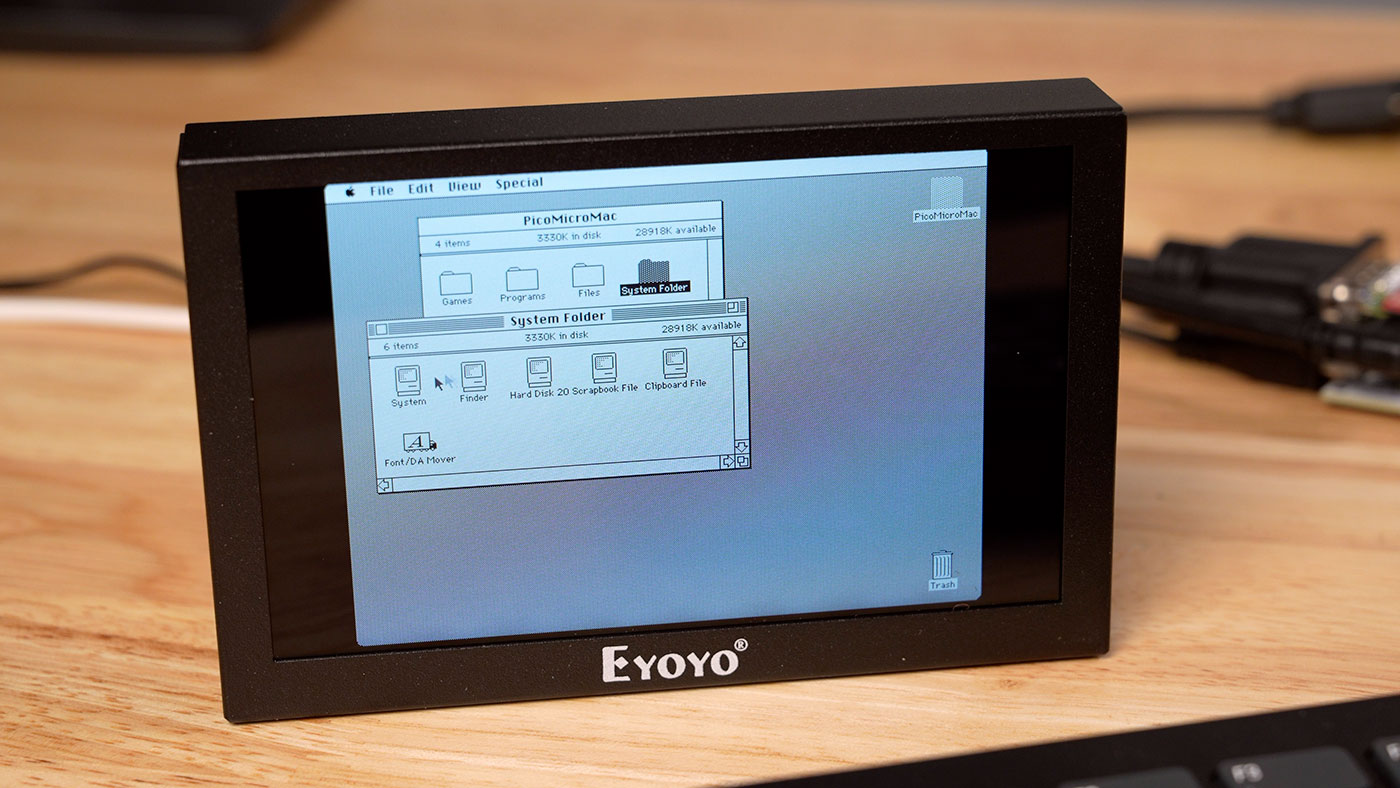
The recent showcase of a functional Macintosh system running on a Raspberry Pi Pico—a microcontroller board smaller than a credit card—transcends a simple DIY achievement. It represents a focal point in a broader technological and cultural shift. While the surface-level appeal is undeniable—a beloved 1980s computer interface resurrected in miniature form—the underlying implications touch on hardware preservation, the philosophy of computing, and the human relationship with technology's past. This analysis delves into the Pico Micro Mac phenomenon, moving beyond the build log to examine why such projects resonate deeply in the mid-2020s.
Technical Alchemy: Squeezing a Mac into an RP2040
At its core, the feat accomplished by developer Matt Evans with the pico-mac firmware is an exercise in extreme software optimization. The Raspberry Pi Pico's RP2040 chip, with its dual ARM Cortex-M0+ cores and 264KB of SRAM, is astronomically more powerful in terms of raw clock speed than the Motorola 68000 that powered the original Macintosh 128K. However, the challenge is not brute force, but meticulous re-creation. The firmware must emulate the 68000 CPU instruction set, manage the original Mac's unique memory mapping, replicate the timing of its custom chips (like the VIA and IWM), and generate a stable VGA signal—all within the constraints of the Pico's resources.
The choice to target System 5.3, from the era before the official "Mac OS" moniker, is strategic. It represents a purer, leaner version of the operating system, demanding less from the emulation layer. The resulting 208KB of usable RAM—a figure that humorously surpasses the original machine's advertised but not fully accessible 128KB—becomes a tangible link to the past, a constraint that defines the authentic experience. This technical narrative highlights a move away from bloated, generalized emulation on powerful PCs towards lean, purpose-built emulation on embedded hardware, prioritizing authenticity and physicality.
The Cultural Engine of Retro-Computing
Why does building a tiny Macintosh captivate audiences? The answer lies in a confluence of cultural currents. First is historical reclamation. For a generation that grew up with sealed, disposable devices and ephemeral cloud services, vintage computers represent a tangible, understandable world. Every component has a purpose; the entire system can be comprehended by a single mind. Projects like the Pico Micro Mac demystify the black box, offering a bridge to that comprehensible past.
Second is the aesthetic and experiential nostalgia, which goes beyond mere memory. The black-and-white UI, the system bomb dialog, the distinctive startup chime—these are sensory artifacts of a specific computing philosophy. Engaging with them is an experiential form of digital archaeology. Furthermore, communities like those around "MARCHintosh" and content creators such as Ron's Computer Videos and Action Retro have created a supportive ecosystem that validates and spreads these pursuits, transforming solitary tinkering into a shared cultural practice.
Analysis: The Hardware Iteration Loop and Democratization
The evolution from the Pico Micro Mac's V2 to V3 adapter board is a microcosm of successful open-hardware development. The initial version, requiring soldering a separate microSD HAT onto header pins, represented the early adopter phase—technically possible but friction-heavy. Ron's V3 design, integrating the SD card reader and using standard headers for a plug-and-play Pico WH, is a classic case of progressive simplification. This iteration directly lowers the skill floor, inviting a wider audience to participate. It mirrors the broader maker movement's trajectory: innovation creates the possibility, and refinement creates accessibility. This cycle is crucial for sustaining interest and moving projects from the realm of experts into educational and hobbyist mainstream.
Legal and Ethical Frontiers of System Preservation
An unavoidable dimension of projects like this is their legal standing. The firmware requires a Macintosh ROM image, which is copyrighted intellectual property. The community typically operates under a tacit understanding of abandonware ethics—the notion that software for long-discontinued platforms, no longer sold or supported by its creator, exists in a gray zone where preservation outweighs strict copyright enforcement. However, as these preservation methods become more mainstream and polished, they may attract greater scrutiny. The Pico Micro Mac sits at this intersection, posing questions about the future of software preservation law. Could such non-commercial, educational efforts eventually pave the way for more formal "right to repair" or "right to emulate" legal frameworks for obsolete technologies?
Educational Potential: A Classroom in a Chip
Beyond hobbyist nostalgia, the Pico Micro Mac holds profound educational value. It is a self-contained historical exhibit and a laboratory for computer science principles. Students can interact with a foundational GUI operating system, understanding concepts like cooperative multitasking, the single-menu bar, and resource forks in their original context. On the hardware side, tracing the signals from the RP2040's programmable I/O (PIO) pins to generate VGA offers a masterclass in low-level timing and display protocols. This hands-on, concrete approach contrasts sharply with abstracted software tutorials, providing a holistic understanding of the complete computing stack, from silicon to user interface.
Conclusion: A Testament to Enduring Ideas
The pint-sized Macintosh built on a Raspberry Pi Pico is far more than a clever trick. It is a cultural artifact of the 2020s, reflecting a desire to reconnect with the physical and conceptual roots of personal computing. It showcases the incredible efficiency of modern microcontrollers when paired with ingenious software. It highlights a community-driven model for preserving digital heritage. And perhaps most importantly, it proves that the ideas embodied in a forty-year-old machine—simplicity, user focus, and integrated design—remain powerful enough to inspire new generations of builders, thinkers, and preservers. In miniaturizing the Mac, we have not diminished its legacy but have instead found a new way to celebrate and perpetuate its foundational role in our digital world.
Further Reading & References
Primary Project: Matt Evans' pico-mac firmware repository and the PicoMicroMac hardware designs represent the core of this technical achievement.
Community Context: The "MARCHintosh" celebration and channels like Ron's Computer Videos provide essential social and tutorial context for the retro-computing movement.
Technical Deep Dive: Documentation for the Raspberry Pi Pico's RP2040 microcontroller, particularly its PIO state machines, is key to understanding how VGA generation is achieved.
Historical Framework: Histories of the original Macintosh development, such as those found in folklore.org, provide the crucial background against which this emulation project gains meaning.