📋 Key Analytical Takeaways
- Minimalism Over Complexity: This workflow challenges the prevailing trend towards complex AI orchestration platforms, demonstrating that lightweight tools (tmux, Markdown, bash) can effectively manage multiple agents.
- Human-in-the-Loop Scaling: The system identifies a cognitive ceiling at approximately 8 parallel agents, highlighting the enduring role of human oversight in AI-augmented development.
- Documentation as Coordination Layer: Structured Markdown specifications (Feature Designs) serve as the critical communication and coordination medium between human and AI collaborators, replacing API calls with shared documents.
- Evolution of Developer Role: The practitioner transitions from a direct coder to a "conductor" or "product lead" managing a team of AI specialists, focusing on high-level design, review, and decision-making.
The Counter-Intuitive Appeal of Manual Agent Management
The landscape of AI-assisted software engineering in 2026 is dominated by sophisticated platforms promising autonomous agent swarms, intelligent orchestrators, and no-code workflow designers. In this context, the methodology described by Manuel Schipper presents a fascinating contrarian approach. Instead of abstracting away the management layer, it embraces manual control through the venerable terminal multiplexer tmux and plain-text Markdown files. This is not a regression but a deliberate design choice prioritizing transparency, direct manipulation, and low latency over automation black boxes.
Historically, software development tooling oscillates between integration and modularity. Heavyweight IDEs consolidate functionality, while Unix philosophy champions small, composable tools. This workflow is a modern incarnation of the latter, applied to the novel problem of multi-agent collaboration. It suggests that for certain cognitive tasks—especially those requiring rapid context switching and nuanced judgment—a visually spatial, manually navigable interface (like separate tmux panes) may outperform a fully automated scheduler that obscures state and decision pathways.
Deconstructing the "Feature Design" as an Agent-Human Contract
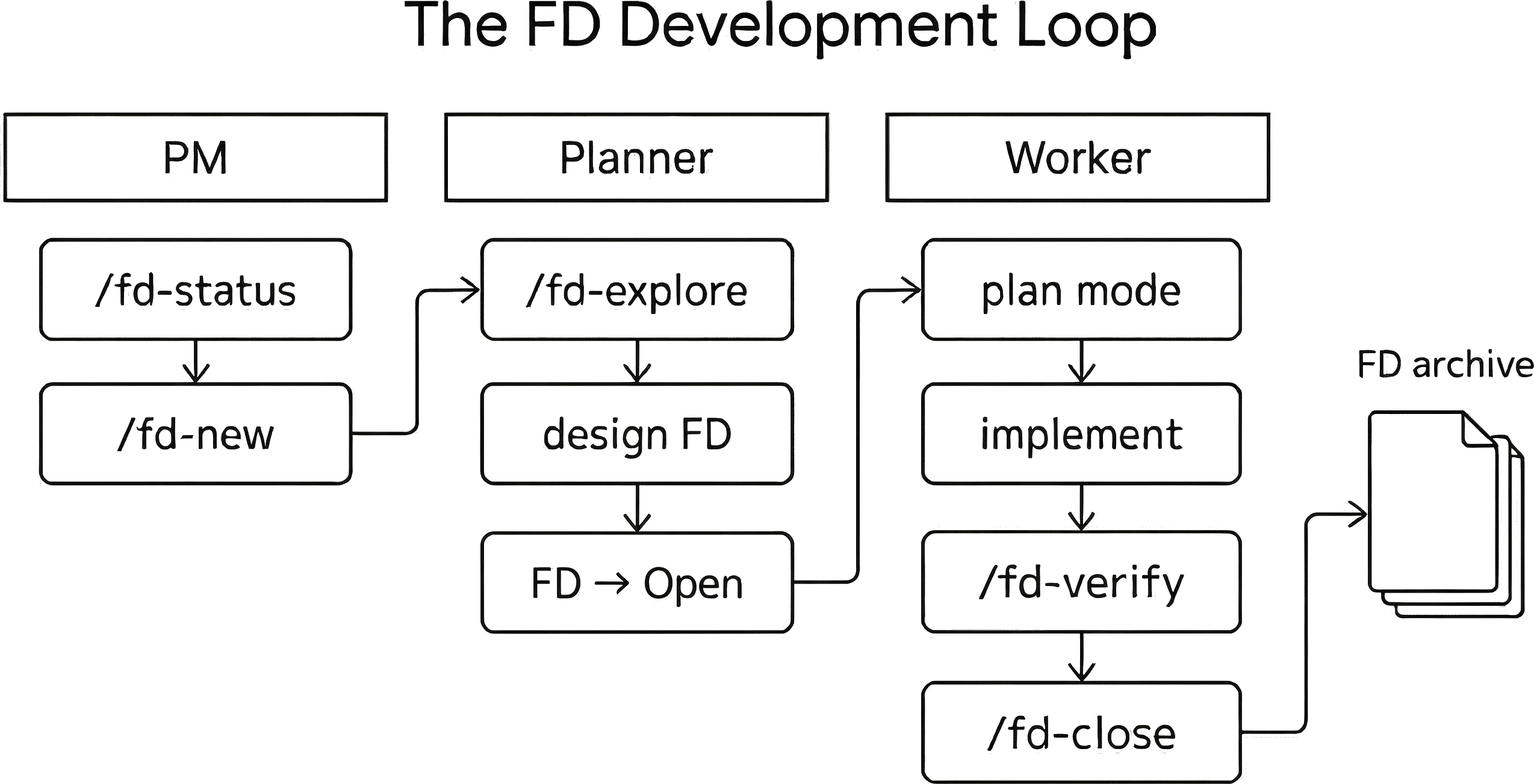
The core innovation lies not in the parallel execution itself, but in the formalized intermediary artifact: the Feature Design (FD) Markdown document. This artifact functions as a binding specification and a shared context memory between the human "Planner" agent and the AI "Worker" agents. Its required sections—problem statement, considered solutions with trade-offs, final implementation plan, and verification steps—enforce a rigor often missing in informal prompting.
From a software engineering theory perspective, an FD resembles a lightweight, executable requirements document. It bridges the gap between high-level intent and low-level code, a gap where AI hallucinations and misunderstandings frequently occur. By forcing the human to articulate pros and cons before implementation, the system embeds critical thinking upstream. The AI's role then shifts from creative problem-solver to a highly competent, detail-oriented implementer working against a clear blueprint. This division of labor mirrors and amplifies effective human team patterns, where product managers/architects define the "what" and "why," and engineers focus on the "how."
The Cognitive Architecture: Why 8 Agents is the Limit
A striking observation from the practice is the self-imposed limit of 4-8 parallel agents, beyond which decision quality degrades. This number offers a concrete data point for discussions on human cognitive bandwidth in augmented workflows. Cognitive Load Theory, developed in educational psychology, distinguishes between intrinsic load (task complexity), extraneous load (poor instructional design), and germane load (schema construction). This workflow ingeniously manages load.
The FD spec reduces intrinsic load for the Worker agent by providing clarity. The tmux window-per-role model and slash commands reduce extraneous load for the human by minimizing interface friction. This freed-up cognitive capacity can then be allocated to germane load: making higher-order strategic decisions across multiple workstreams. The limit of ~8 likely corresponds to the capacity of working memory for distinct, active contexts. It implies that even with perfect tooling, the human integrator remains the bottleneck, not the AI agents. This has profound implications for tool design: instead of focusing solely on agent autonomy, we should invest in interfaces that expand human situational awareness and decision-making throughput.
Bash Slash Commands: The Unsung Glue of the Workflow
While tmux provides the visual framework and Markdown the content layer, the suite of bash aliases (presented as slash commands like /fd-new, /fd-deep) constitutes the workflow's automation engine. These are not mere shortcuts; they are encapsulated processes that maintain system state. /fd-init bootstraps a project with the necessary directory structures and conventions, enforcing consistency. /fd-status provides an at-a-glance dashboard. /fd-deep is particularly interesting—it launches four "Opus" model agents to tackle a hard design problem, effectively running a mini brainstorming session.
This approach bypasses the need for a dedicated backend service or database. The file system (docs/features/) becomes the state store, and the slash commands are idempotent operators on that state. This offers brutal simplicity, debuggability, and version control friendliness (every state change is a file change). However, it also presents analytical questions about scalability in very large teams and the potential for race conditions, suggesting this model is currently optimal for single-lead or small, tightly-knit augmented teams.
Broader Implications and Future Trajectories
This manual parallel agent system is more than a productivity hack; it is a prototype for a new kind of human-computer collaboration. It challenges the narrative that AI will simply automate developers away. Instead, it depicts a future where developers leverage AI to act as force multipliers, managing a "team" of specialized digital assistants. The developer's value shifts from typing code to defining problems, evaluating alternatives, making architectural decisions, and verifying outcomes—the highest-value activities in the software lifecycle.
Looking forward, we can anticipate evolution in several directions. First, the core concepts (FD specs, role separation) could be integrated into next-generation IDEs as first-class citizens. Second, the slash command layer could evolve into a discoverable, extensible plugin system for agent management. Third, and most significantly, research might focus on "meta-agents" or interfaces designed to help the human manager of AI agents better track context, detect conflicts between parallel workstreams, and visualize the collective progress of their digital team. The goal would not be to remove the human from the loop, but to augment their capabilities to successfully manage 16, 32, or more parallel agents without hitting cognitive overload, truly unlocking the collaborative potential of artificial intelligence.
In conclusion, this hands-on, minimalist methodology provides a vital counterpoint to the trend of increasing abstraction in AI tooling. It emphasizes control, transparency, and the strategic elevation of the human role. As the industry grapples with how best to integrate powerful AI models into creative work, the lessons from this parallel tmux-based workflow—centered on clear specifications, manageable cognitive loads, and simple, composable tools—will undoubtedly inform the more sophisticated collaborative platforms of tomorrow.
Further Analysis & Context
Historical Context: The use of terminal multiplexers for managing multiple processes dates back to tools like screen in the 1980s. Applying this paradigm to AI agents connects decades-old sysadmin practices with cutting-edge LLM capabilities, demonstrating how robust old tools can solve new problems.
Industry Trend Contrast: This approach stands in direct contrast to platforms like Cursor's agentic mode, GitHub's Copilot Workspace, or dedicated "AI workforce" platforms (e.g., SmythOS, CrewAI). Those aim for full automation and orchestration, while this method advocates for assisted, direct control.
Psychological Framework: The workflow can be analyzed through the lens of "Distributed Cognition," where cognitive processes are offloaded onto external artifacts (the FD documents, the tmux layout) and agents. The system successfully distributes the cognitive load of software development across human and AI actors using a shared, inspectable environment.